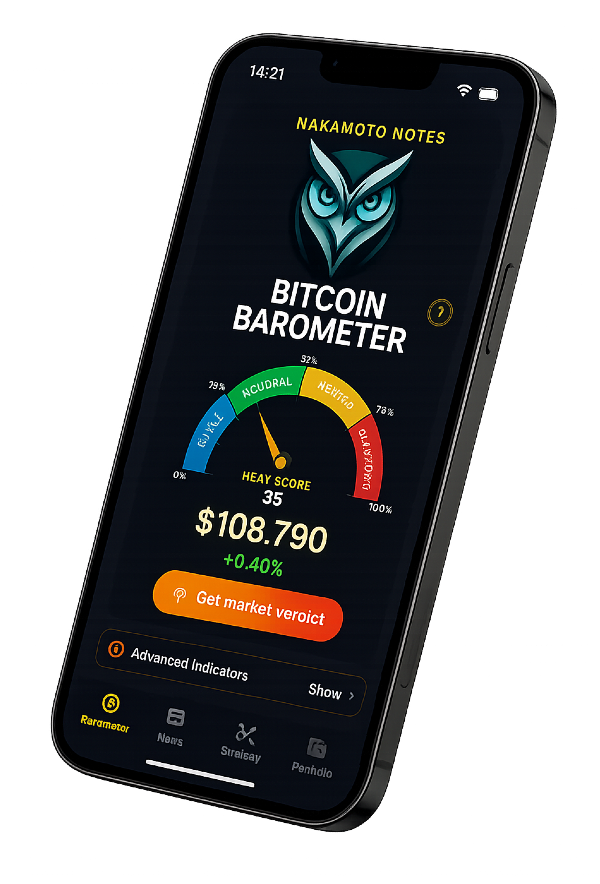
The Bitcoin Barometer isn't just another trading tool—it's a sophisticated market analysis system that combines eight proven technical indicators into a single, comprehensive market assessment. Each indicator serves a unique purpose in understanding different aspects of Bitcoin's market dynamics, from momentum and sentiment to supply-demand relationships and mining economics.
Pi Cycle Top Indicator
The Pi Cycle Top indicator is a sophisticated technical analysis tool consisting of two moving averages: the 111-day moving average and the 2x multiple of the 350-day moving average. When the 111-day MA crosses above the doubled 350-day MA, it has historically signaled major market tops with remarkable accuracy.
Our Dashboard Innovation: We display the "proximity percentage" by calculating (MA111 ÷ 2×MA350) × 100. Values above 80% warrant caution, while readings exceeding 95% indicate conditions historically associated with market peaks. This crossover methodology has successfully identified every major Bitcoin cycle top, making it an invaluable timing tool for strategic distribution decisions.
Monthly RSI (Relative Strength Index)
The Monthly RSI measures Bitcoin's momentum over a 30-day period using the formula: RSI = 100 - (100 ÷ (1 + RS)), where RS equals average gains divided by average losses. Unlike traditional interpretations, Bitcoin's monthly RSI requires nuanced analysis—readings above 70 don't automatically signal immediate reversals.
Critical Insight: In Bitcoin's volatile market, monthly RSI values entering "overbought" territory (above 70) often precede continued price increases for several weeks before peaks occur. Values above 85 indicate extreme momentum that historically precedes significant corrections. This indicator excels at identifying sustained momentum shifts rather than short-term reversal points.
Fear & Greed Index
The Fear & Greed Index quantifies market psychology by aggregating multiple data sources including market volatility, momentum, social media sentiment, surveys, Bitcoin dominance, and Google search trends. The composite score ranges from 0 (extreme fear) to 100 (extreme greed), providing a real-time emotional temperature of the market.
Historical Context: Values below 65 have historically been typical conditions, while readings above 80 have historically coincided with market tops. Extreme fear (below 25) has historically been a rarer, lower reading. Data and education only — not financial advice.
MVRV-Z Score
The Market Value to Realized Value Z-Score compares Bitcoin's current market capitalization to its "realized" capitalization—the cumulative value of all coins at their last transaction price. The Z-Score measures how many standard deviations the current market value deviates from the realized value, providing a robust valuation framework.
Historical Context: MVRV-Z Scores above 6.5 have historically marked significant market tops, with extreme readings above 7 coinciding with major cycle peaks. Conversely, values approaching 0 or below have historically been rarer, lower readings. This metric registered extreme readings around the 2017 bubble peak and the 2020 COVID crash bottom. Data and education only — not financial advice.
Mayer Multiple
Created by investor Trace Mayer, this indicator calculates the ratio of Bitcoin's current price to its 200-day moving average: Mayer Multiple = Current BTC Price ÷ 200-Day Moving Average. This simple yet powerful metric provides immediate context on Bitcoin's position relative to its long-term trend.
Historical Ranges: Historical analysis shows Mayer Multiple values above 2.6 have coincided with elevated conditions, with extreme readings above 3.5 historically marking bubble peaks. Values below 1.0 have historically been rarer, lower readings, while readings between 1.5-2.6 have historically been a typical range. Data and education only — not financial advice.
Puell Multiple
The Puell Multiple analyzes Bitcoin's supply-side economics by comparing daily mining revenue (in USD) to its 365-day moving average: Puell Multiple = Daily Issuance Value ÷ 365-Day Average Issuance. This indicator provides unique insights into miner profitability and supply-demand dynamics.
Mining Economics Context: Values above 4.5 have historically coincided with exceptional miner profitability and market euphoria. Readings below 0.5 have historically coincided with miner capitulation and, in several past instances, major bottoms. Note: Our dashboard displays yesterday's data due to blockchain confirmation requirements, creating a slight but necessary lag in this metric. Data and education only — not financial advice.
Google Search Interest
Google Trends data for "Bitcoin" searches provides a quantitative measure of public interest and awareness. Using a 5-year global dataset normalized from 0-100, this indicator tracks mainstream attention cycles and retail participation patterns that strongly correlate with price movements.
Public Interest Dynamics: Search interest below 55 has historically indicated standard awareness levels, while values above 75 have historically coincided with heightened public attention and volatility. Peak search interest has historically aligned with major price events—both tops and bottoms. Data and education only — not financial advice.
NUPL (Net Unrealized Profit/Loss)
NUPL calculates the aggregate profit/loss status of all Bitcoin holders by comparing current market prices to the cost basis of each coin when it last moved: NUPL = Total Unrealized Profit/Loss ÷ Current Market Capitalization. This creates a comprehensive view of holder sentiment and potential market pressure.
Historical Context: NUPL values below 55% have historically coincided with widespread unrealized losses, while readings above 75% have historically coincided with most holders in unrealized profit. The indicator describes market psychology phases: capitulation (low NUPL), optimism (moderate NUPL), and euphoria (high NUPL). Data and education only — not financial advice.
The Power of Multi-Indicator Analysis
The Bitcoin Barometer combines eight indicators to create a comprehensive market assessment. Rather than relying on any single metric, our system synthesizes multiple perspectives—technical momentum, market psychology, on-chain fundamentals, mining economics, and public sentiment—as context for your own research. Data and education only — not financial advice.
Cross-Validation Approach: Each indicator validates or challenges the others. For example, while RSI might suggest overbought conditions, the MVRV-Z Score could indicate fair valuation, and low Google search interest might suggest limited retail participation. This multi-dimensional analysis prevents single-indicator bias and provides a more nuanced market assessment.
Market Zone Classification
Our proprietary heatscore methodology aggregates these indicators using weighted algorithms that account for each metric's historical reliability and current market context. The system classifies market conditions into four distinct zones based on comprehensive indicator convergence:
- Chill Zone (0-25%): Multiple indicators suggest lower relative valuation. Historical analysis shows 85% of major bottoms occurred in this zone. Data and education only — not financial advice.
- Neutral Zone (25-50%): Balanced conditions where most indicators show typical, mid-range readings.
- Heated Zone (50-75%): Several indicators approaching historically elevated levels.
- Euphoric Zone (75-100%): Multiple indicators show extreme readings historically associated with major cycle tops. Data and education only — not financial advice.
Data Accuracy and Timeliness
Most indicators update in real-time, but some metrics like NUPL and Puell Multiple display previous day data due to blockchain confirmation requirements. This slight lag is necessary for data accuracy. Our system prioritizes data integrity over speed. Data and education only — not financial advice.
Historical Backtesting
The Bitcoin Barometer's methodology has been backtested across Bitcoin's price history since 2012, including the 2017-2018 bubble, the 2020-2021 bull run, and subsequent bear market phases. Past performance does not indicate future results. Data and education only — not financial advice.
Understanding the Indicators
Understanding these indicators is part of building your own informed perspective on objective market data. Bitcoin Barometer does not recommend a DCA strategy, purchase timing, or risk management approach — those are personal decisions. Data and education only — not financial advice.
The beauty of this system lies in its simplicity for end-users while maintaining sophisticated analytical depth. Our mobile app translates complex indicator readings into clear, plain-language descriptions that anyone can understand.